
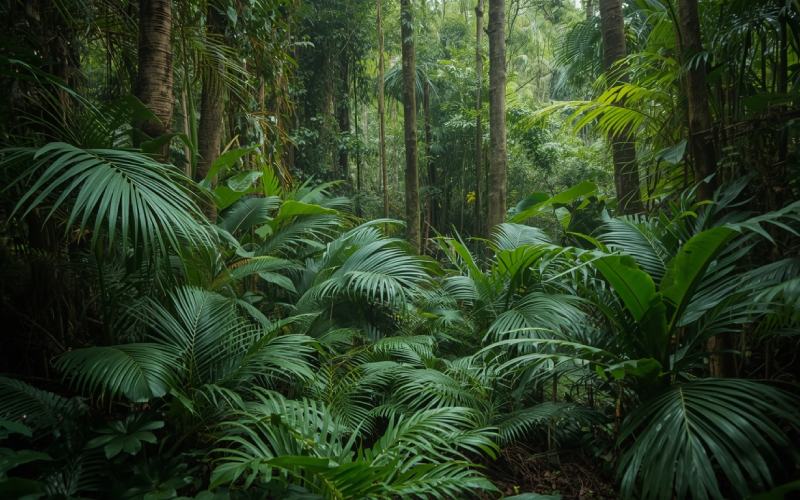
Producers in the rainforest are the foundation of one of Earth’s most complex ecosystems. These organisms capture energy from sunlight and convert it into chemical energy through photosynthesis, providing the starting point for food webs that support countless species.
From enormous rainforest trees to vines, palms, ferns, and aquatic plants, producers occupy almost every available layer of the forest. Their importance extends beyond feeding wildlife. They also influence carbon storage, water cycling, habitats, and the overall structure of rainforest ecosystems.
Understanding these organisms makes it easier to see why protecting rainforest vegetation matters for both biodiversity and people.
What Exactly Is a Producer?
In ecology, living organisms are commonly grouped into producers, consumers, and decomposers.
Producers, also called autotrophs, can make their own organic food rather than obtaining it by eating other organisms. Most rainforest producers use photosynthesis, a process in which plants use sunlight, water, and carbon dioxide to produce sugars while releasing oxygen.
Rainforests provide plenty of warmth and moisture, but plants face intense competition for sunlight. Tall trees form dense canopies that capture much of the available light, leaving lower layers considerably darker.
As a result, rainforest plants have developed different strategies for living at different heights.
The Layer Cake: Where Rainforest Producers Live
A rainforest is not simply a flat collection of trees. It has several vertical layers, and each layer provides different conditions for plants.
The Emergent Layer
The emergent layer contains some of the tallest trees in the forest. Their crowns rise above much of the surrounding canopy, giving them access to abundant sunlight.
However, these trees also face strong winds and greater exposure to heat and drying conditions.
Examples include:
- Kapok trees: Large tropical trees with broad crowns that can rise above the surrounding forest.
- Brazil nut trees: Important Amazonian trees that contribute significantly to the structure and productivity of the forest.
The Canopy
The canopy forms the dense upper roof of the rainforest. It receives substantial sunlight and supports an enormous variety of plants and animals.
Important producers found here include:
- Lianas: Woody climbing vines that use trees as structural support to reach sunlight.
- Epiphytes: Plants such as orchids and bromeliads that grow on other plants without taking nutrients directly from their host.
- Fruit-producing trees: Many canopy trees produce fruits that provide food for birds, mammals, and other wildlife.
The Understory
Far less sunlight reaches the understory because much of it has already been intercepted by the canopy.
Plants living here have adaptations that allow them to make efficient use of limited light. Many have broad leaves that maximize their ability to capture available sunlight.
Common understory producers include:
- Palms
- Philodendrons
- Heliconias
- Young trees and shrubs
- Various herbs and ferns
The Forest Floor
The forest floor receives very little direct sunlight in many tropical forests. Even so, some plants can survive in these low-light conditions.
Ferns, mosses, seedlings, and shade-tolerant plants can be found here.
It is also important to distinguish producers from decomposers. Some organisms associated with the forest floor obtain nutrients from decaying organic matter rather than producing their own food through photosynthesis.
Producers in the Rainforest Ecosystem
Producers form the base of the rainforest food web.
The process begins when plants capture solar energy and store it in organic compounds. Herbivores then obtain energy by feeding on plants or plant products. Carnivores and omnivores obtain energy by feeding on other animals.
For example:
Sunlight → Rainforest plants → Herbivores → Predators
This energy flow helps explain why producers are essential to the entire ecosystem. If primary producers decline significantly, the organisms that depend on them can also be affected.
Carbon Storage
Rainforest vegetation stores carbon in living plants, roots, and surrounding ecosystems. When forests are cleared or burned, some of that stored carbon can enter the atmosphere.
Water Cycling
Trees and other plants release water vapor through transpiration. Combined with evaporation, this contributes to the movement of water through rainforest ecosystems and can influence regional rainfall patterns.
Habitat Creation
Plants create the physical structure of the rainforest. Trees provide nesting sites, vines create pathways, and bromeliads can hold small amounts of water that support other organisms.
The Battle for Light: Rainforest Plant Adaptations
Competition for sunlight has driven many remarkable adaptations.
Drip Tips
Many tropical leaves have pointed ends that help water drain from their surfaces. Rapid drainage can help leaves remain functional in a warm, wet environment.
Buttress Roots
Some large rainforest trees develop broad, above-ground buttress roots. These structures can provide stability and may help trees grow successfully in tropical soils where nutrients are often concentrated near the surface.
Carnivorous Plants
Some plants supplement their mineral nutrients by trapping and digesting small animals, particularly insects.
Pitcher plants are a well-known example. They remain producers because they perform photosynthesis, but their carnivorous behavior provides additional nutrients that can be scarce in certain environments.
Tertiary Consumers in the Rainforest
Producers support herbivores, which in turn support predators.
At higher levels of a food web are tertiary consumers, which may feed on secondary consumers and can include apex predators.
Examples in tropical rainforest ecosystems include:
- Jaguars: Major predators in parts of the Amazon and other regions of Central and South America.
- Harpy eagles: Powerful forest raptors that hunt animals including monkeys and sloths.
- Large snakes: Anacondas and some pythons can occupy high positions in particular food webs.
Predators can influence herbivore populations and therefore indirectly affect vegetation. This type of interaction is one reason food webs are more complicated than a simple linear food chain.
Three Consumers in the Rainforest
Here are three examples that illustrate different consumer levels.
1. Three-Toed Sloth — Primary Consumer
Three-toed sloths feed largely on leaves and are closely associated with trees in the rainforest canopy. As herbivores, they obtain energy directly from producers.
2. Toucan — Secondary Consumer
Toucans eat a variety of foods, including fruits and small animals. Their mixed diet means they can occupy different positions within food webs depending on what they are eating.
3. Green Anaconda — High-Level Predator
Green anacondas are large aquatic and semi-aquatic snakes that prey on animals such as fish, birds, mammals, and reptiles. Their exact position in a food web depends on the ecosystem and prey involved.
Spotlight: Fascinating Rainforest Producers
The rainforest contains many unusual plants whose survival strategies demonstrate the complexity of tropical ecosystems.
The Strangler Fig
Strangler figs can begin life high in the branches of another tree after their seeds are deposited there, often by animals.
The young plant sends roots toward the ground while growing around its host. Over time, the fig can develop a large root-and-stem structure and compete strongly with the host for resources.
Eventually, the host may die, leaving the mature fig supported by its own extensive structure.
Bromeliads
Bromeliads include plants related to pineapples. Many species form leaf structures capable of collecting water.
These small pools can become miniature habitats for insects and other organisms. Decomposing organic material can also accumulate in the collected water, contributing nutrients to the plant’s environment.
Rafflesia
Rafflesia is famous for producing enormous flowers and for its strong odor, which resembles rotting material and helps attract pollinators such as flies.
Unlike ordinary green plants, Rafflesia is a highly specialized parasite that obtains nutrients from its host rather than relying on normal photosynthesis.
It is therefore important to distinguish Rafflesia from typical rainforest producers when discussing photosynthetic plants.
Why Rainforest Producers Matter to Humans
Rainforest plants are important not only because they support wildlife but also because humans depend on rainforest ecosystems in many ways.
Rainforests provide food, materials, ecosystem services, and biological resources that have contributed to scientific research.
Some plant compounds from tropical ecosystems have also played roles in medicine. For example:
- Quinine: Historically obtained from Cinchona trees and important in malaria treatment.
- Curare-related compounds: Chemicals from several tropical plants have contributed to the development of medicines used in modern medicine.
- Rosy periwinkle: Compounds derived from this plant helped lead to important treatments for certain cancers.
These examples demonstrate why rainforest biodiversity has scientific value. However, it is inaccurate to claim that every undiscovered rainforest plant could contain a cure for a particular disease. Scientific discoveries require extensive research and testing.
Major Threats to Rainforest Producers
Rainforest producers face several major environmental pressures.
Deforestation
Forests are cleared for activities including agriculture, cattle ranching, infrastructure, mining, and other forms of land use. Removing vegetation can destroy habitats and reduce carbon storage.
Fragmentation
When continuous forests are divided by roads, farms, or other development, plant and animal populations can become isolated. Forest edges may also experience different temperature, moisture, and wind conditions than intact interiors.
Climate Change
Changes in temperature, rainfall, and drought patterns can place additional stress on tropical forests. Severe or prolonged drought can increase tree mortality and make forests more vulnerable to fire.
How Can We Help Protect Rainforest Producers?
Protecting rainforest ecosystems requires action at many levels, but individual choices can also support broader conservation efforts.
Choose Responsibly Sourced Products
Look for credible certification when purchasing wood and paper products. Certification systems can provide information about how products were sourced, although certification alone does not solve every conservation problem.
Consider the Environmental Impact of Food Choices
Agricultural expansion is an important driver of deforestation in some tropical regions. Understanding where food comes from and supporting more sustainable production systems can help reduce environmental pressure.
Support Forest Conservation
Conservation organizations, responsible tourism programs, and community-led forest initiatives can contribute to protecting rainforest habitats.
Frequently Asked Questions
What are the main producers in the Amazon rainforest?
The Amazon contains thousands of producer species, including large trees, palms, vines, epiphytes, shrubs, ferns, and aquatic plants. Important examples include Brazil nut trees, rubber trees, palms, orchids, bromeliads, and many other tropical species.
How do producers in the rainforest get sunlight in the understory?
Understory plants are adapted to low-light conditions. Many have broad leaves and efficient light-capturing systems that allow them to use the limited sunlight that passes through the canopy. Brief patches of stronger light, sometimes called sunflecks, can also be important.
Are there aquatic producers in the rainforest?
Yes. Tropical rivers, lakes, and wetlands contain aquatic plants and algae that perform photosynthesis. The Amazon basin, for example, is home to giant water lilies such as Victoria amazonica.
What happens if producers are removed from the food web?
Removing major producers can disrupt the entire food web. Herbivores lose important food sources, and predators can subsequently be affected because fewer prey animals are available.
The loss of vegetation can also affect soil stability, carbon storage, water cycling, and habitat quality.
Conclusion
Producers in the rainforest are much more than background greenery. They are the foundation of rainforest food webs and play essential roles in carbon storage, water cycling, habitat creation, and ecosystem stability.
From towering canopy trees to tiny ferns and aquatic plants, these organisms have developed extraordinary adaptations for surviving in one of Earth’s most competitive environments.
Protecting rainforest producers means protecting the wider ecosystems that depend on them. Understanding their role is therefore an important first step toward appreciating why tropical forests are so valuable to biodiversity, science, and the planet.



