
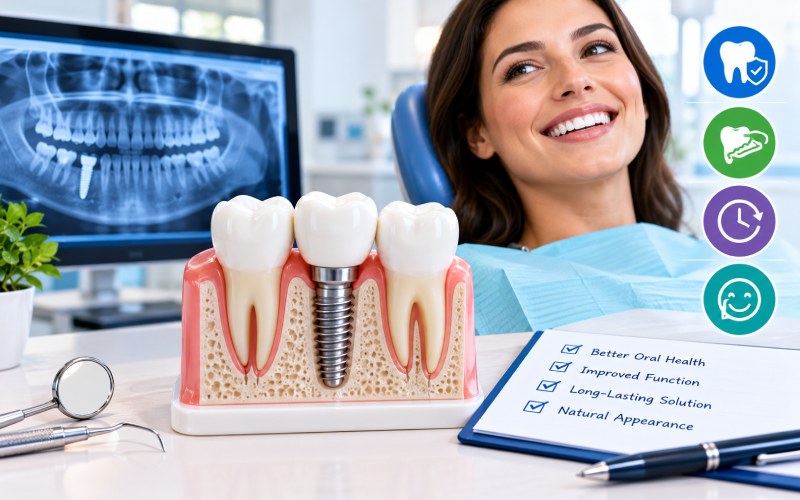
Dental implants have become a widely used option for replacing missing teeth. They are designed to restore both the appearance and function of natural teeth while providing a stable foundation for a dental crown, bridge, or other restoration.
But are dental implants worth the investment when viewed from a long-term oral health perspective?
For many patients, implants can provide excellent durability, stability, and functional benefits. They can also help preserve the jawbone in the area where a tooth has been lost. However, implants involve surgery, healing time, maintenance, and a higher initial cost than some alternatives.
The right choice depends on factors such as oral health, bone condition, overall health, budget, and the condition of the remaining natural teeth. Understanding the advantages and limitations can help you have a more informed discussion with a qualified dental professional.
Key Takeaways
- Dental implants can provide a long-lasting solution for missing teeth when properly placed and maintained.
- Because implants are anchored in the jawbone, they can provide greater stability than many removable tooth-replacement options.
- Implants can help reduce bone loss in the area of a missing tooth by providing stimulation through the implant structure.
- The initial cost of implants is usually higher than some alternatives, although long-term value varies from patient to patient.
- Natural teeth should generally be preserved when they can be predictably treated and maintained.
- Dental implants are not suitable for every patient, so an individualized evaluation is important.
Understanding Dental Implants
A dental implant is a small post, commonly made from titanium or another biocompatible material, that is surgically placed into the jawbone. It serves as an artificial tooth root.
After placement, the implant goes through a healing process called osseointegration. During this process, the surrounding bone develops a close connection with the implant, providing a stable foundation for a replacement tooth.
Once healing is sufficient, a dental restoration such as a crown can be attached.
A typical implant restoration can therefore involve several stages:
- Evaluation and treatment planning
- Implant placement
- Healing and integration with the jawbone
- Placement of an abutment when appropriate
- Attachment of the final restoration
The exact process and timeline vary depending on the patient’s oral health, bone condition, number of missing teeth, and type of restoration.
Why Dental Implants Can Be a Long-Term Solution
One of the major advantages of dental implants is their durability. With appropriate care and regular dental maintenance, implants can remain functional for many years.
However, it is important to distinguish the implant itself from the restoration placed on top of it. The implant fixture may last for decades, while crowns and other components can experience normal wear and may eventually need repair or replacement.
Long-term success depends on several factors, including:
- Oral hygiene
- Regular dental examinations
- Gum health
- Bone quality and quantity
- Proper implant placement
- Overall health
- Smoking status
- Management of conditions that affect healing
Dental implants are not maintenance-free. Brushing, cleaning between teeth, professional dental care, and monitoring for gum inflammation remain important after treatment.
Preserving Jawbone After Tooth Loss
One important difference between implants and some other tooth-replacement options is their relationship with the jawbone.
After a natural tooth is removed, the bone that previously supported its root may gradually lose volume because it no longer receives the same stimulation from the tooth root.
An implant can provide functional stimulation to the surrounding bone and may help maintain bone in the area of the missing tooth.
Preserving bone can also help maintain the structure of the mouth and provide support for the surrounding teeth. However, the amount of bone preservation varies between individuals, and additional procedures may sometimes be necessary when significant bone loss has already occurred.
Dental Implants and Facial Appearance
Tooth loss can affect more than the appearance of a smile. Significant bone loss following tooth loss can change the shape and support of the tissues around the mouth.
By replacing the missing tooth root, an implant can help maintain bone in the treated area. This may contribute to preserving the existing oral and facial structure.
However, dental implants should not be viewed as a guaranteed way to prevent facial aging or create a particular appearance. Their primary purpose is to restore oral function and replace missing teeth.
Cost Considerations
Dental implants typically have a higher upfront cost than removable dentures or some dental bridges. The final price can vary considerably depending on the number of implants needed, the type of restoration, diagnostic procedures, and whether additional treatments are required.
Additional procedures may include bone grafting, tooth extraction, or treatment of existing gum disease.
When considering cost, it is useful to look beyond the initial procedure. Some alternatives may require adjustments, repairs, or replacement over time, while implant restorations can also require maintenance or eventual replacement.
As a result, there is no universal answer about which option is the least expensive over a lifetime.
Patients should request a detailed treatment estimate that explains:
- Implant and surgical fees
- Diagnostic costs
- Restoration costs
- Additional procedures
- Follow-up appointments
- Potential future maintenance
This provides a clearer picture of the total financial commitment.
Dental Implants vs. Other Tooth-Replacement Options
Dental implants are only one way to replace missing teeth. Depending on the situation, a dentist may recommend a bridge, removable denture, or another treatment.
| Option | Main Advantage | Potential Limitation |
| Dental Implant | Stable, fixed replacement and helps maintain bone in the treatment area | Higher initial cost and requires surgery |
| Dental Bridge | Can replace a missing tooth without implant surgery | Usually relies on neighboring teeth for support |
| Removable Denture | Can replace several missing teeth and may be more affordable initially | Can move during use and requires ongoing maintenance |
| Natural Tooth Preservation | Keeps the patient’s original tooth | Only possible when the tooth can be predictably saved |
The best option depends on the patient’s individual circumstances rather than a single treatment being universally superior.
When Saving a Natural Tooth May Be Better
Dental implants are not automatically preferable to natural teeth.
When a natural tooth can be successfully treated and maintained, preserving it may be an important option to consider. Depending on the problem, treatment could involve periodontal therapy, restorative dentistry, root canal treatment, or other procedures.
In some cases involving gum disease or supporting bone loss, periodontal treatment may help stabilize and preserve a natural tooth.
A dentist or periodontist can assess whether a tooth has a reasonable long-term prognosis before extraction is considered.
This is particularly important because removing a natural tooth is irreversible, while treatment decisions should take into account the condition of the tooth and the patient’s overall oral health.
Potential Risks and Complications
Dental implant surgery is generally considered a well-established treatment, but it is still a surgical procedure and carries potential risks.
Possible complications include:
- Infection
- Inflammation around the implant
- Implant failure
- Damage to nearby structures
- Nerve-related complications
- Sinus-related complications for certain upper-jaw implants
- Bone loss around the implant
- Delayed healing
The risk of complications can be influenced by factors such as smoking, uncontrolled diabetes, poor oral hygiene, existing gum disease, and other conditions that affect healing.
A thorough evaluation before treatment can help identify potential risk factors.
What Is Peri-Implantitis?
Peri-implantitis is an inflammatory condition affecting the tissues around a dental implant and can involve loss of supporting bone.
Good oral hygiene and regular professional monitoring are important because inflammation around an implant can affect its long-term stability.
Patients should follow their dentist’s recommendations for brushing, cleaning between teeth, professional cleanings, and follow-up examinations.
Signs such as persistent swelling, bleeding, discomfort, or changes around an implant should be discussed with a dental professional rather than ignored.
Who May Need Additional Evaluation Before Getting Implants?
Not everyone is immediately ready for implant placement.
A dental professional may need to evaluate:
- Available jawbone
- Gum health
- Remaining teeth
- Bite and chewing forces
- Oral hygiene
- Medical history
- Smoking habits
- Medications
- Conditions that may affect healing
If there is insufficient bone, a bone-grafting procedure may sometimes be considered. If active gum disease is present, it may need to be treated before implant placement.
These additional steps can affect both the treatment timeline and overall cost.
How to Protect Your Investment
Once an implant has been placed, maintaining it properly is essential.
Good long-term habits include:
- Brush your teeth regularly with fluoride toothpaste.
- Clean between your teeth and around the implant as recommended.
- Attend routine dental examinations.
- Follow professional cleaning recommendations.
- Avoid smoking.
- Report unusual swelling, bleeding, pain, or looseness promptly.
- Follow all post-treatment instructions from your dental professional.
An implant may be designed to last for many years, but its long-term performance depends heavily on the health of the surrounding tissues and the condition of the restoration.
Are Dental Implants Worth It?
For many people with missing teeth, dental implants can be a valuable long-term treatment because they offer stability, restore chewing function, and can help preserve bone in the area of tooth loss.
However, “worth it” depends on the individual.
A patient with good oral health, sufficient bone, and a suitable treatment plan may be an excellent candidate. Another patient may benefit more from preserving a natural tooth, choosing a bridge, using a removable restoration, or addressing underlying gum disease first.
The financial cost is also only one part of the decision. Treatment complexity, recovery time, maintenance requirements, expected longevity, and overall oral health should all be considered.
Frequently Asked Questions
How long can dental implants last?
Dental implants can remain functional for many years, and some can last for decades with appropriate care. However, the implant itself and the crown or other restoration have different lifespans, and maintenance or replacement may eventually be necessary.
Do dental implants prevent bone loss?
Dental implants can help maintain bone in the area of a missing tooth because they replace the function of a tooth root. However, they do not necessarily prevent all bone changes, and individual results vary.
Are dental implants better than dentures?
Neither option is universally better. Implants generally provide a more fixed and stable solution, while dentures may be less invasive and have a lower initial cost. The appropriate choice depends on oral health, preferences, budget, and treatment suitability.
Are dental implants better than bridges?
Dental implants do not require the same type of support from neighboring teeth as traditional bridges. However, bridges can be an effective alternative in appropriate cases and do not require implant surgery.
Can a natural tooth be saved instead of getting an implant?
Sometimes. If a natural tooth can be predictably treated and maintained, preserving it may be preferable to extraction. A dentist or specialist can evaluate the tooth and explain its long-term prognosis.
What can cause a dental implant to fail?
Implant failure can have several causes, including problems with healing, infection or inflammation, insufficient bone support, excessive forces, smoking, and other health or oral-hygiene factors.
How much do dental implants cost?
The cost varies widely depending on the number of implants, type of restoration, location, diagnostic work, and whether additional procedures are required. A personalized estimate from a dental professional is the best way to understand the total cost.
Conclusion
Dental implants can be an effective and durable option for replacing missing teeth, offering stability, restored function, and the potential to preserve bone in the area of tooth loss. For many patients, these advantages can make implants a worthwhile long-term investment.
However, implants are not automatically the best choice for everyone. Preserving a healthy or treatable natural tooth should be considered whenever possible, while bridges and removable dentures can provide useful alternatives for appropriate patients.
The most suitable treatment depends on your teeth, gums, bone health, overall health, lifestyle, and financial considerations. A qualified dentist, periodontist, or oral surgeon can evaluate your situation and explain the benefits, risks, alternatives, and expected long-term maintenance before you make a decision.



