
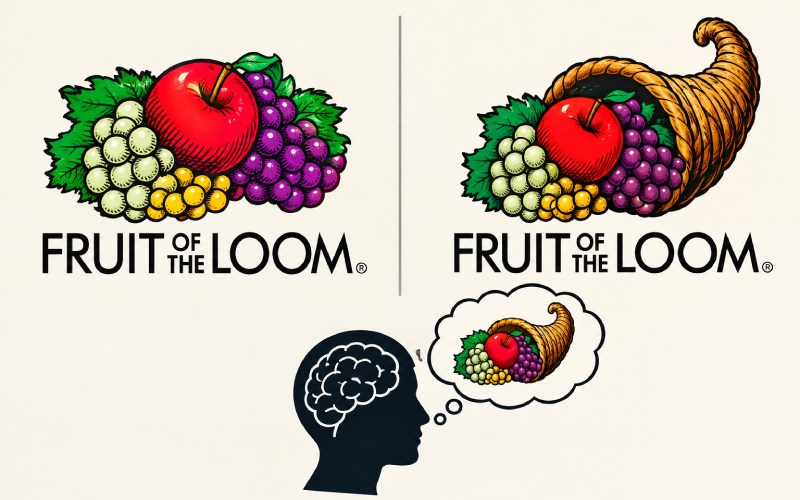
If you’ve ever searched for the Fruit of the Loom cornucopia to settle an argument, you’re definitely not the only one. For years, people have debated whether the famous Fruit of the Loom logo once included a cornucopia, or horn of plenty, behind the fruit.
The memory is surprisingly vivid for many people. Some insist they remember seeing a woven horn filled with fruit on old clothing labels, packaging or advertisements. Yet when older versions of the logo are examined, the supposed cornucopia becomes much harder to find.
So, did Fruit of the Loom really have a cornucopia in its logo?
The answer is no documented official Fruit of the Loom logo has been established as featuring a cornucopia. The long-running belief is generally discussed as an example of the Mandela effect, where groups of people share a similar memory that doesn’t match the available historical record.
Here’s what the evidence, brand history and psychology of memory can tell us about the mystery.
What Is the Fruit of the Loom Cornucopia?
The phrase “Fruit of the Loom cornucopia” usually refers to a specific image people remember: a basket-shaped or horn-shaped container holding the fruit associated with the Fruit of the Loom logo.
The actual brand imagery is built around a cluster of fruit, including grapes, leaves and an apple. Over the years, the exact colors, shading, typography and arrangement have changed.
The controversy begins because many people remember a curved container behind or underneath that fruit.
That memory can feel extremely convincing. However, a strong memory isn’t necessarily proof that the remembered object was actually part of the original logo.
Did the Fruit of the Loom Logo Ever Have a Cornucopia?
Based on documented trademark and brand-history records, there is no reliable evidence that an official Fruit of the Loom logo incorporated a cornucopia.
Several types of historical material can be used to investigate the claim:
Trademark Records
Historical trademark filings provide an important source for studying how a company’s official logo has been used.
Fruit of the Loom has registered multiple versions of its name and fruit imagery over the years. These records show changes in artwork, typography and composition, but they do not establish a cornucopia as an official element of the brand’s logo.
Vintage Packaging
Old packaging and clothing labels are another useful source.
Vintage Fruit of the Loom products show variations in printing quality, colors and layouts. However, the recognizable fruit cluster remains the central visual element rather than a documented horn of plenty.
Advertisements and Catalogs
Period advertisements can help distinguish the official logo from artwork used around it.
Seasonal advertising sometimes incorporates harvest-related imagery, which can include baskets, autumn decorations or other representations of abundance. Seeing such imagery near a familiar brand can potentially contribute to a later memory of the logo itself.
Brand Guidelines
Official brand materials help establish which versions of a logo were approved for use.
The documented Fruit of the Loom identity centers on the fruit arrangement rather than a cornucopia.
Myth vs. Historical Evidence
| Claim | Common Memory | Available Evidence |
| The old logo contained a cornucopia | A woven horn appeared behind the fruit | No documented official logo establishes one |
| The horn was removed during a redesign | A later redesign supposedly deleted it | No confirmed redesign shows the removal of a cornucopia |
| Old underwear packages had the horn | Vintage packaging supposedly displayed it | Historical packaging shows variations of the fruit design |
| The logo originally included a basket | The fruit was sitting inside a container | Officially documented imagery centers on the fruit cluster |
Why Do So Many People Remember a Cornucopia?
The persistence of this memory is what makes the Fruit of the Loom example particularly interesting.
Human memory isn’t a perfect recording of every visual detail. Instead, the brain reconstructs memories using context, expectations and previously learned associations.
Several psychological effects may help explain the cornucopia memory.
1. Schema Completion
A cornucopia is strongly associated with fruit, harvest and abundance.
When people see a collection of fruit arranged in a traditional or old-fashioned style, the brain may automatically associate it with a horn of plenty.
In other words, the missing object fits the surrounding story so naturally that the brain can effectively fill in the gap.
2. Source Confusion
People encounter logos in many different environments.
A Fruit of the Loom logo might appear next to seasonal advertising, Thanksgiving decorations or other harvest-themed artwork. Years later, the brain may remember the overall visual scene without accurately separating which elements belonged to the logo and which belonged to the surrounding advertisement.
3. Memory Gist
People tend to remember the overall meaning of an image better than every individual visual detail.
Someone may remember seeing an old-fashioned fruit logo associated with abundance and harvest. Over time, that general memory can become more specific, eventually turning into a recollection of a fruit-filled cornucopia.
4. Repetition and Social Reinforcement
Memory can become more confident when a story is repeated.
If someone hears other people say, “I remember the cornucopia too,” the shared recollection may feel increasingly convincing.
That doesn’t necessarily make the memory historically accurate. It simply demonstrates how social reinforcement can influence confidence in memory.
5. Visual Similarity
Curved leaves, fruit outlines, shadows and surrounding packaging elements can sometimes create shapes that resemble the opening or edge of a container.
At a quick glance, those shapes may contribute to the impression that the fruit was sitting inside a horn.
A Brief History of the Fruit of the Loom Logo
The Fruit of the Loom identity has changed visually over the decades, but its central fruit imagery has remained recognizable.
Early Designs
Older versions of the brand used more detailed and painterly illustrations. Printing methods of the period also affected how the fruit and lettering appeared.
Mid-20th Century
The artwork became more standardized as the company needed branding that could be reproduced consistently across different products and printed materials.
Late 20th Century
The fruit became more recognizable through stronger colors, clearer outlines and refinements to the accompanying wordmark.
Modern Era
Digital publishing introduced new requirements. Logos needed to remain recognizable on websites, product listings, clothing tags and small screens.
The colors, shading and proportions may differ between versions, but the documented identity continues to revolve around the fruit cluster.
Old Fruit of the Loom Logo vs. Today’s Logo
People comparing an old Fruit of the Loom logo with a modern version may notice several differences.
Color
Older printed materials can appear softer or less saturated because of printing processes, paper quality and aging.
Outlines
Earlier illustrations often have less precise edges than modern digital artwork.
Typography
The wordmark has undergone visual changes, including differences in letter spacing, weight and presentation.
Fruit Arrangement
The positioning and overlap of the fruit and leaves have changed slightly across different versions.
However, one important point remains: these documented changes do not establish the addition or removal of a cornucopia.
Fruit of the Loom Underwear Packaging and the Memory
Fruit of the Loom underwear packaging is often mentioned in discussions about the cornucopia.
That makes sense because millions of people encountered the logo repeatedly on everyday clothing and packaging.
Packaging has changed substantially over time. Different products, retailers, years and markets have used different layouts, colors and photographic styles.
The logo could also appear alongside decorative elements that weren’t actually part of the brand mark.
Why Packaging Can Be Misleading
Several things can affect how an old package is remembered:
- Printed colors fade over time.
- Plastic packaging can create reflections and distortions.
- Product photographs can be cropped.
- Shadows can create additional shapes.
- Seasonal displays can place unrelated harvest artwork near the logo.
- Small images online may lose important visual details.
For anyone investigating the claim, high-resolution photographs of original packaging are much more useful than low-quality social-media images.
Is the Fruit of the Loom Cornucopia a Mandela Effect?
The Fruit of the Loom cornucopia is frequently described as a Mandela effect example.
The term refers to situations in which a large number of people appear to share a particular false or inaccurate memory.
The important part is that people can genuinely remember something without intentionally making it up.
The Fruit of the Loom debate illustrates several features of collective memory:
- Shared associations: Fruit and cornucopias are culturally connected.
- Memory reconstruction: The brain rebuilds memories rather than replaying them like video.
- Context blending: Nearby images and advertisements can become part of a remembered scene.
- Social reinforcement: Other people’s recollections can strengthen confidence.
The experience can therefore be genuine even when the remembered detail isn’t supported by historical records.
How to Research the Fruit of the Loom Logo Yourself
If you want to investigate the cornucopia claim rather than relying on internet arguments, you can follow a simple research process.
Step 1: Check Trademark Records
Search historical trademark databases for Fruit of the Loom word and design marks.
Pay attention to both the written descriptions and the actual trademark images.
Step 2: Find Vintage Advertisements
Look through newspaper archives, old catalogs, magazines and department-store advertisements.
Compare the logo itself with decorative artwork surrounding it.
Step 3: Examine Vintage Packaging
Search for photographs of unopened or well-preserved products from different decades.
Focus specifically on the logo rather than the entire package design.
Step 4: Compare Multiple Years
Don’t rely on a single image.
Create a timeline showing how the logo changed from one period to another. This makes it easier to distinguish genuine historical changes from differences caused by printing or photography.
Step 5: Check the Source
A viral image isn’t automatically historical evidence.
Ask:
- Where did the image come from?
- Is the original physical product identifiable?
- Is the date known?
- Does another independent source show the same design?
- Is the image an advertisement, parody, fan creation or official brand material?
This approach is useful for researching other supposed logo changes and Mandela effect claims as well.
Why Fake and Edited Images Make the Debate Harder
The internet contains many images that appear to show a Fruit of the Loom cornucopia.
But an image alone doesn’t establish authenticity.
Some examples may be:
- Fan-made artwork
- Parodies
- Digital edits
- Incorrect reproductions
- Counterfeit packaging
- AI-generated images
- Images posted without historical context
This is why provenance matters.
An image connected to a dated physical product, archival collection or official record is much stronger evidence than an anonymous image shared on social media.
Why the Cornucopia Myth Continues
The mystery remains popular because it combines several things people naturally enjoy: nostalgia, branding, psychology and disagreement over personal memories.
Fruit of the Loom is also an especially powerful example because the brand has been familiar to generations of consumers.
The cornucopia itself makes the story even more believable because it fits the theme perfectly.
A fruit-filled horn represents abundance. A brand called Fruit of the Loom already contains the word “fruit.” The visual connection is almost too convenient.
That may be precisely why the false memory is so persistent.
What Designers Can Learn From the Debate
The controversy offers some useful lessons for anyone working in branding and visual communication.
Context Matters
A logo never exists completely on its own. Packaging, advertisements, backgrounds and nearby imagery can affect how people perceive it.
Test Logos at Different Sizes
A design that looks clear at full resolution can create unexpected shapes when reduced to a small label or product thumbnail.
Maintain Clear Brand Guidelines
Clear usage rules can help prevent unofficial variations from becoming confused with the actual brand identity.
Archive Historical Versions
Companies can make future research easier by maintaining accessible archives of previous logos, packaging and advertising campaigns.
What Marketers Can Learn
The Fruit of the Loom debate also demonstrates an important distinction between brand history and consumer memory.
A customer can sincerely remember a logo differently from the way the company actually used it.
For marketers, that means customer recollections can be valuable, but they should not automatically be treated as historical documentation.
If a brand addresses a popular misconception, the strongest approach is to provide evidence rather than mock people for remembering differently.
Myth vs. Evidence
Myth: The Company Secretly Removed the Cornucopia
There is no established historical record showing an official cornucopia being removed during a logo redesign.
Myth: Everyone’s Old Packaging Had the Horn
Personal memories vary, and online examples can include altered, unofficial or misleading images. Documented packaging should be checked before drawing conclusions.
Myth: Any Image With the Cornucopia Proves It Existed
Not necessarily.
The source, date, context and authenticity of an image all matter.
A Simple Memory Experiment
The Fruit of the Loom debate can even be used as a simple demonstration of how memory works.
Show someone the modern fruit logo, a traditional cornucopia image and a harvest-themed advertisement. Remove the images and ask the person to describe the logo from memory.
The exercise can demonstrate how familiar concepts influence recall.
People may unintentionally add elements that fit the overall theme.
Frequently Asked Questions
Did Fruit of the Loom ever officially use a cornucopia?
There is no reliable historical documentation establishing a cornucopia as part of the official Fruit of the Loom logo.
Why do people remember a Fruit of the Loom cornucopia?
The memory may result from a combination of visual association, harvest imagery, source confusion, memory reconstruction and repeated social discussion.
Is the Fruit of the Loom cornucopia part of the Mandela effect?
Yes. The claim is commonly discussed as an example of the Mandela effect because many people report a similar memory that isn’t supported by the documented logo history.
Did the old Fruit of the Loom logo look different?
Yes. The brand has gone through visual changes involving colors, typography, shading and the arrangement of the fruit. These differences can make older versions look noticeably different from today’s logo.
Was the cornucopia on Fruit of the Loom underwear packaging?
There is no established evidence that an official Fruit of the Loom logo on underwear packaging included a cornucopia. Some surrounding artwork, packaging layouts or unrelated images may contribute to the memory.
How can I check whether an old Fruit of the Loom logo is authentic?
Look for dated physical packaging, historical advertisements, trademark records and reputable archival sources. Be cautious with images that have no identifiable origin.
Why does the cornucopia seem so familiar?
The combination of fruit and a horn of plenty is culturally familiar. Because the two concepts naturally belong together, the brain can easily connect them even when the horn wasn’t part of the original logo.
Are online cornucopia images always fake?
No. Some may represent fan art, parody, recreated designs or other contexts rather than the official logo. The key is determining where the image came from and what it actually represents.
Final Verdict: Did Fruit of the Loom Have a Cornucopia?
The Fruit of the Loom cornucopia remains one of the internet’s most recognizable logo mysteries.
Many people genuinely remember seeing a horn of plenty behind the fruit. However, the available documented history does not establish a cornucopia as part of the company’s official logo.
The more interesting question may therefore be not “How could everyone be wrong?” but “Why does the same incorrect detail feel so familiar to so many people?”
The answer lies in the way human memory works. We don’t simply store every visual experience exactly as it happened. We reconstruct memories using context, expectations, associations and information encountered later.
In the case of Fruit of the Loom, fruit, harvest imagery and the familiar concept of a cornucopia make an especially convincing combination.
So the next time someone insists that the old Fruit of the Loom logo definitely had a cornucopia, there’s no need to turn it into an argument. Compare the historical records, look at the original packaging and examine the evidence together.
The mystery is less about a missing horn and more about the fascinating ways our memories are built.



